Numerī Rōmānī.
Learn about Roman numerals, counting and additions. Convert any number to its Roman numeral and back, and read how the Romans said it.


Numerī
| Symbol | Value | Latin word |
|---|---|---|
| I | 1 | ūnus |
| V | 5 | quīnque |
| X | 10 | decem |
| L | 50 | quīnquāgintā |
| C | 100 | centum |
| D | 500 | quīngentī |
| M | 1000 | mīlle |
Roman numbers are additive: to make larger numbers you can combine the values of the symbols. For example, II is 2, VI is 6 and LXXVII is 77. The higher values are always to the left of the lower values, and we read the number from left to right, adding the values together as we go.
To add two numbers we combine all their symbols into a single string, order that string from highest value to lowest, and then trade the doubled-up symbols in for bigger ones. As an example, adding MMDCCXXVII (2727) and MDCCXXVIII (1728) looks like this:MMDCCXXVIIOnly that last step has a rule to remember: 2 D's become an M, 2 V's become an X, 5 I's become a V and 5 X's become an L.
MDCCXXVIII
-------
MMMDDCCCCXXXXVVIIIII
MMMMCCCCLV = 4455
Subtractive Combinations
When a smaller symbol stands before a larger one, you subtract it from the larger one. In practice, this was not used much because it makes numbers much harder to add up. Adding 2 numbers without subtractive combinations is much easier than adding 2 numbers with subtractive combinations. The following subtractive combinations do occur:
| Form | Reads as | Value | Instead of |
|---|---|---|---|
| IV | 1 before 5 | 4 | IIII |
| IX | 1 before 10 | 9 | VIIII |
| XL | 10 before 50 | 40 | XXXX |
| XC | 10 before 100 | 90 | LXXXX |
| CD | 100 before 500 | 400 | CCCC |
| CM | 100 before 1000 | 900 | DCCCC |
Romans wrote IIII and VIIII all the time. The Colosseum's numbered gates are perfect witnesses: gate 44 is carved XLIIII — subtractive for the forty, additive for the four, in one breath. Roman calendars went further and wrote XIIX for 18. Subtractive spelling became a rule centuries after Rome fell, partly because IV was more concise than IIII.
The words subtract too
Subtraction is not only a habit of the symbols; it is built into the number words themselves. Latin counts the last two numbers before a round ten downwards from it, so 18 and 19 are not “ten and eight” and “ten and nine” but two and one taken away from twenty:
| Number | Latin | Literally |
|---|---|---|
| 18 | duodēvīgintī | two from twenty |
| 19 | ūndēvīgintī | one from twenty |
| 28 | duodētrīgintā | two from thirty |
| 99 | ūndēcentum | one from a hundred |
The pattern holds all the way up: ūndē- is “one from” and duodē- is “two from”, glued to the number being counted down from.
Counting
You do not learn a thousand numbers. Instead, you learn a few dozen, and then you build up from there.
First we start with the numbers 1 through 20:
| Number | Numeral | Latin |
|---|---|---|
| 1 | I | ūnus, ūna, ūnum |
| 2 | II | duo, duae, duo |
| 3 | III | trēs, tria |
| 4 | IV | quattuor |
| 5 | V | quīnque |
| 6 | VI | sex |
| 7 | VII | septem |
| 8 | VIII | octō |
| 9 | IX | novem |
| 10 | X | decem |
| Number | Numeral | Latin |
|---|---|---|
| 11 | XI | ūndecim |
| 12 | XII | duodecim |
| 13 | XIII | trēdecim |
| 14 | XIV | quattuordecim |
| 15 | XV | quīndecim |
| 16 | XVI | sēdecim |
| 17 | XVII | septendecim |
| 18 | XVIII | duodēvīgintī |
| 19 | XIX | ūndēvīgintī |
| 20 | XX | vīgintī |
The first three are the only cardinals below a hundred that carry gender: ūnus and duo have a separate masculine, feminine and neuter form, while trēs has one form for masculine and feminine and another for neuter. From quattuor up to a hundred the words never change shape, no matter how the noun beside them is used. Those first three also decline for case:
| Case | One | Two | Three |
|---|---|---|---|
| Nominative | ūnus, ūna, ūnum | duo, duae, duo | trēs, tria |
| Genitive | ūnīus | duōrum, duārum, duōrum | trium |
| Dative | ūnī | duōbus, duābus, duōbus | tribus |
| Accusative | ūnum, ūnam, ūnum | duōs, duās, duo | trēs, tria |
| Ablative | ūnō, ūnā, ūnō | duōbus, duābus, duōbus | tribus |
Past twenty the counting goes by tens, and past a hundred by hundreds. The tens are fixed words, but the hundreds are plural adjectives that agree with what they count — that is what the -ae, -a endings below stand for.
| Number | Numeral | Latin |
|---|---|---|
| 10 | X | decem |
| 20 | XX | vīgintī |
| 30 | XXX | trīgintā |
| 40 | XL | quadrāgintā |
| 50 | L | quīnquāgintā |
| 60 | LX | sexāgintā |
| 70 | LXX | septuāgintā |
| 80 | LXXX | octōgintā |
| 90 | XC | nōnāgintā |
| 100 | C | centum |
| Number | Numeral | Latin |
|---|---|---|
| 100 | C | centum |
| 200 | CC | ducentī, -ae, -a |
| 300 | CCC | trecentī, -ae, -a |
| 400 | CD | quadringentī, -ae, -a |
| 500 | D | quīngentī, -ae, -a |
| 600 | DC | sescentī, -ae, -a |
| 700 | DCC | septingentī, -ae, -a |
| 800 | DCCC | octingentī, -ae, -a |
| 900 | CM | nōngentī, -ae, -a |
| 1000 | M | mīlle |
We can then combine these numbers to make vīgintī (et) ūnus for 21, ducentī quadrāgintā septem for 247, and so on.
Ordinals
Unlike most of the cardinals, the ordinals are perfectly ordinary adjectives of the bonus type: three endings, agreeing with their noun. Only the masculine is listed below. The first two are words in their own right; the rest are built straight off the number they rank.
| Number | Latin | In English |
|---|---|---|
| 1st | prīmus | first |
| 2nd | secundus | second |
| 3rd | tertius | third |
| 4th | quārtus | fourth |
| 5th | quīntus | fifth |
| 6th | sextus | sixth |
| 7th | septimus | seventh |
| 8th | octāvus | eighth |
| 9th | nōnus | ninth |
| 10th | decimus | tenth |
Abacus
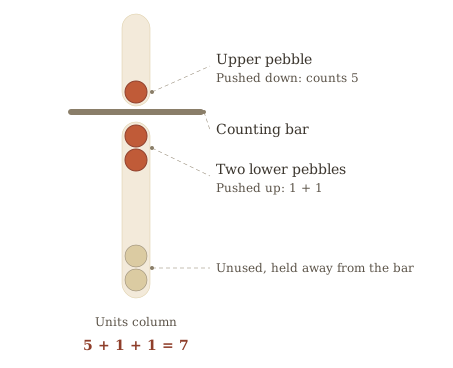
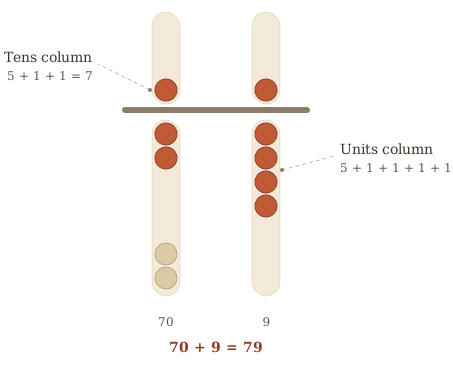
The Roman hand abacus was one of the earliest portable calculating devices, used in ancient Rome. It was a simple device with grooves for pebbles ordered into columns with 2 grooves per column. Each column reprented a factor of ten, and the pebbles were moved to represent the numbers. Each column had a lower groove holding four pebbles worth one each, and a shorter upper groove holding a single pebble worth five. Actual arithmetic happened on the device. Roman numerals were never meant to be calculated with, they were meant to record what the pebbles showed. The pebbles were calculī, "little stones", and that is where calculate comes from.
As an example, the following 2 illustrations show the numbers 7 and 79 on the abacus.